.svg)
Privacy Isn’t a Tech Problem, It’s a UX Problem

Privacy has emerged as a major priority for crypto builders and users. The onchain privacy problem has been identified as a key factor preventing crypto from achieving full mainstream adoption, with the rise of stablecoin payments also providing an impetus to keep users’ transaction data out of the public eye. If the mainstream is to join the onchain ecosystem, they can’t afford for their entire financial history to be viewable by anyone with an internet connection.
The crypto community has spent enormous energy debating technology choices, no single solution has yet emerged as the primary option to take onchain privacy mainstream. With many approaches still at nascent stages, it’s likely there’s still some way to go before a dominant onchain privacy standard emerges.
However, one thing is certain. History shows us that users value technology choices only as far as they make their lives easier. The vast majority of crypto users still use centralized exchanges, yet have begun to migrate as the experience provided by DEXs improves: ~20% of global spot crypto trading volume was handled by DEXs in Q3 2025, up from ~10% in 2024.
It’s likely that onchain privacy will evolve in same way. With this in mind, we can view the adoption of onchain privacy solution through the lens of UX, with tradeoffs and benefits to each approach.
The Onchain Privacy Trilemma
Proposed by Wei Dai, the Onchain Privacy Trilemma identifies three qualities of onchain privacy solutions and argues that only two are achievable at the same time.
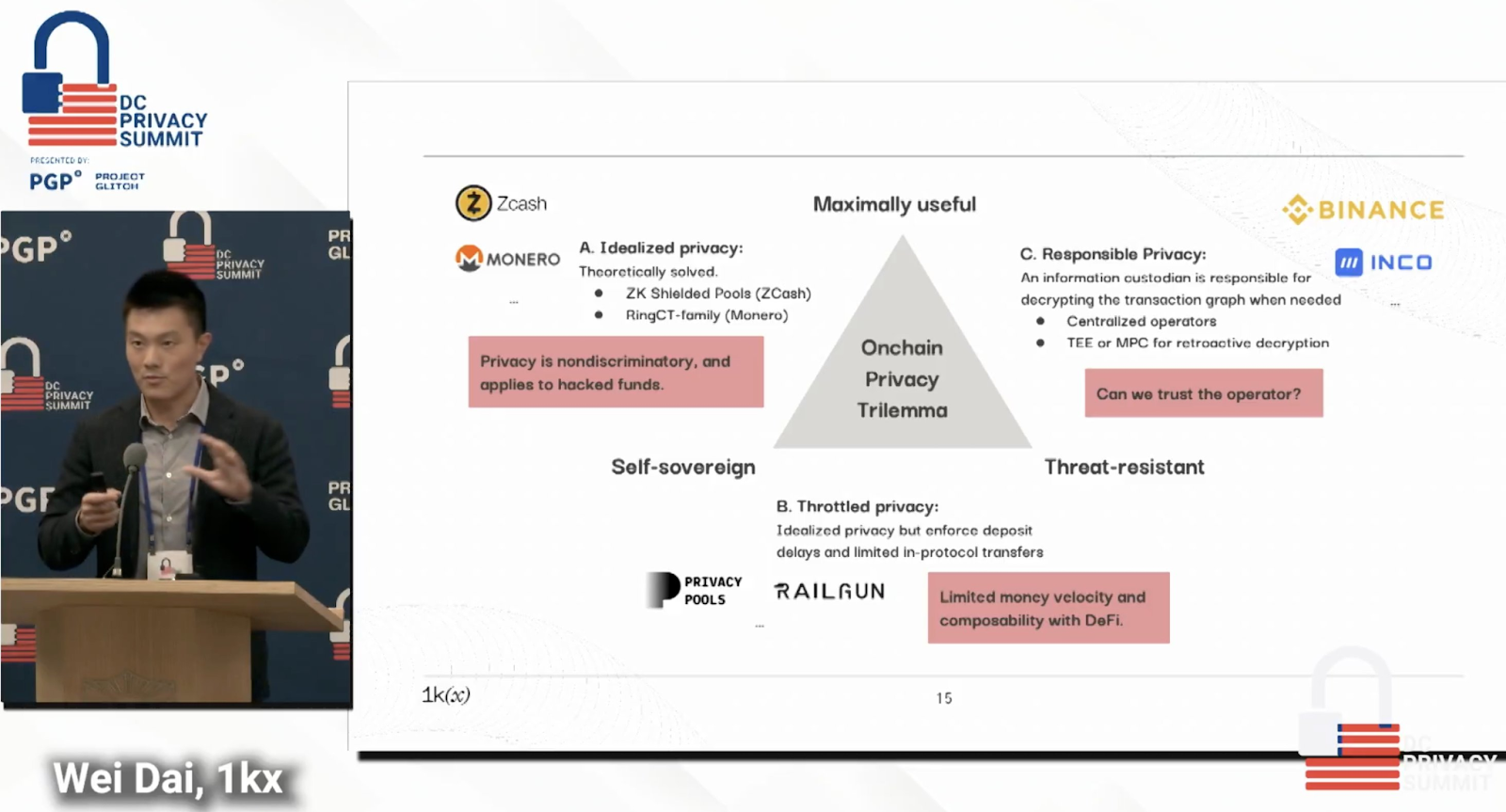
Some approaches prioritize both sovereignty and threat-resistance, meaning users have total control over their assets and privacy and enjoy a high level of resistance against threats, but suffer from poor user experience. Others combine this sovereignty preference with usefulness but sacrifice threat-resistance and potentially open users up to mixing their funds with those of criminal enterprises. Finally, some solutions involve a trusted party but are both useful and threat-resistant. Users will each have their own priorities and perhaps ideologies when it comes to onchain privacy, landing them on one side of this trilemma. And there are of course nuances to each approach.
However, a look back at the history of technology shows us that any solution that seeks to achieve mainstream adoption must optimize for one key feature: usability.
The Power of Good UX
In 1991, Phil Zimmermann launched PGP (Pretty Good Privacy). The first email encryption tool, PGP enabled users to keep their email exchanges private. At its peak, PGP had a userbase in the low millions, a small fraction of total email users.
For years, many took this as evidence that people simply didn’t care about privacy, that it simply wasn’t important to them. After all, there was a way for them to keep their emails private, they just didn’t want to use it, opting instead to send standard, non-encrypted emails.
Then, in 2016, something changed. The big Web2 companies began including end-to-end encryption (E2EE) in their standard products. Apple integrated E2EE into iMessage and Signal launched, bringing a dedicated privacy experience to tens of millions of users. Privacy was suddenly a standard.
So what changed? In two words: user experience. PGP was onerous to set up, and required users to share their private keys, which non-technical users simply did not know how to do. It wasn’t that mainstream users didn’t want privacy, it was that the technical barrier to them integrating it into their daily lives was too great. Privacy needed to come to them.
An app like Signal not only provided a more secure encryption solution than PGP, it also came in the form of an application that users were comfortable with: they could get it from the App Store, sign up with their phone number, and didn’t have to learn anything new. Today, Signal has an estimated 70 million users, while billions send E2EE messages with iMessage and other E2EE apps every day.
The inclusion of privacy in these apps was totally seamless, to the point of being unnoticeable. This is a lesson that those building onchain privacy solutions today can learn from: for widespread adoption, privacy must cater to the user experience expectations of the public, not require them to learn more.
Onchain Privacy’s Usability Problem
Crypto’s cypherpunk roots and high percentage of technically minded users have resulted in onchain privacy solutions that look more like PGP than Signal.
Privacy-focused chains work fine when a user has been onboarded, but sacrifice the liquidity of the existing blockchain ecosystem and require users to bridge from the chains they’re used to using. On top of this, many also require installing a new wallet. This is an issue for builders too, who often have to learn a new language and architecture.
Other solutions impose controls at the protocol level and deploy commitment-based privacy methods that limit composability and interoperability with the rest of the ecosystem, making them incompatible with many of the most popular onchain applications.
All of these solutions have their place, and this is not to suggest that they don’t serve a valuable purpose: many users value self-sovereignty and decentralization above all else, just as some users today still opt to use PGP to send encrypted emails. If a user just wants to self-custody funds and send private transactions to others—and has a decent technical understanding—these solutions work just fine. Some might also be OK with the limited liquidity of a private chain.
But for those looking to join the onchain ecosystem for its efficiency, composable apps, and speed relative to the traditional financial system who don’t have these concerns or a base of technical knowledge—the vast majority of people—these solutions are likely to fall short.
Flexible Privacy, Seamless UX
So what would an onchain privacy solution that met the usability needs of the general public look like?
First of all, it would need to meet them where they are. The barrier to installing a wallet and transacting on a high-liquidity chain is relatively low, as demonstrated by the millions around the world who already use onchain stablecoins and engage in DeFi. Privacy needs to be baked into their standard experience—it needs to come to them. This means a solution compatible with existing chains and existing wallets that does not require bridging or new software.
Secondly, it would need to be compatible with the qualities that make crypto so powerful in the first place: composability and speed. Users should be able to access DeFi, voting, gaming, and other applications on their chain of choice—privately.
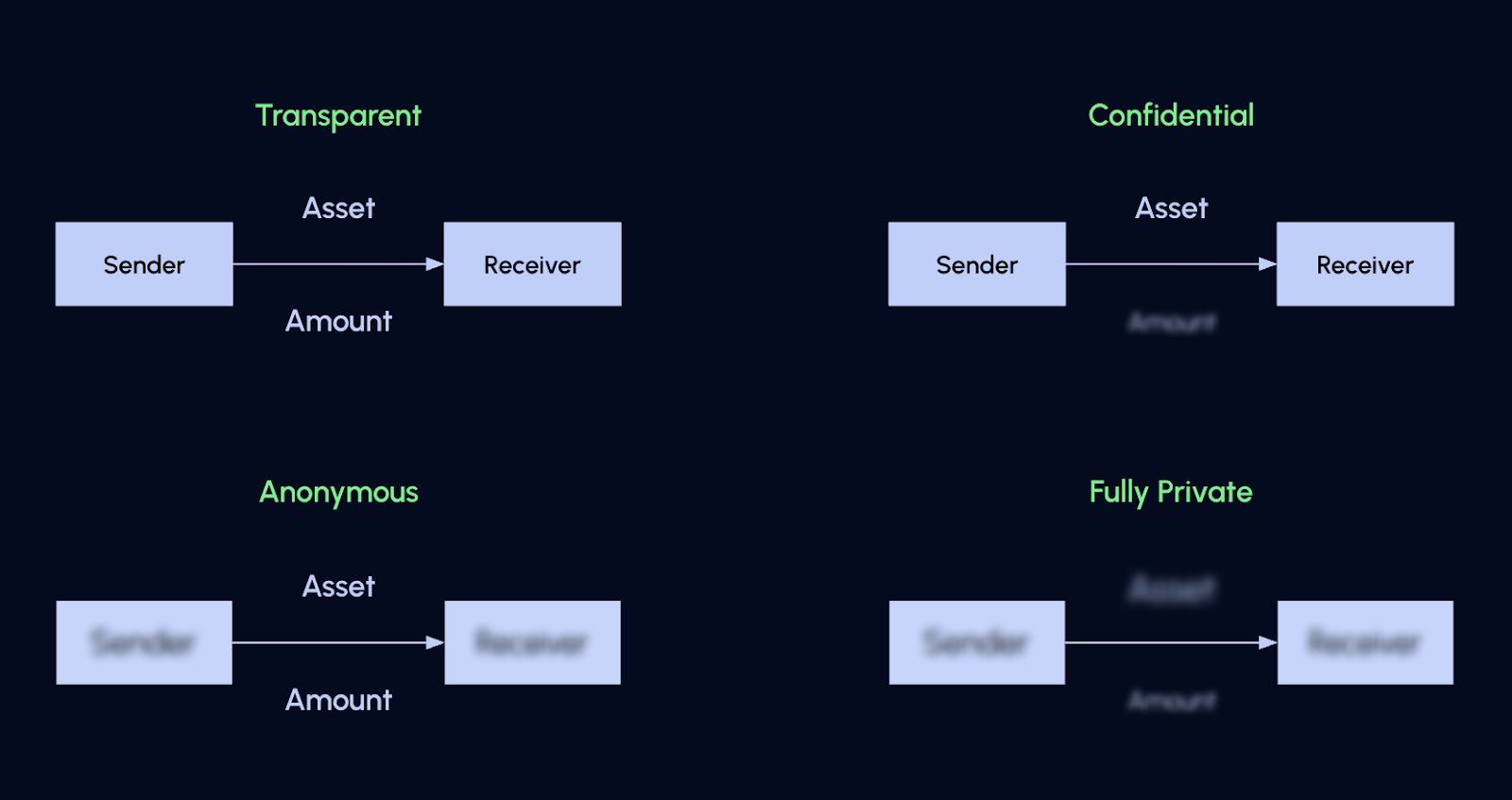
Finally, developers and startups should be able to have flexibility about the level of privacy they need for payments. There are various levels of onchain privacy, from full transparency (what we mostly have today) to full anonymity. Users should be able to easily achieve the level of privacy they need on the applications they already use.
The Inco Approach
Inco uses a novel architecture and an encryption-based approach to offer users and builders flexible, programmable privacy where they are. Users can transact on the chains they’re already comfortable using their existing wallet with little-to-no additional technical overhead. They’re not required to bridge, and can benefit from using existing, high-liquidity chains.
Builders and existing application developers can supercharge their applications with privacy with little extra development overhead, leveraging shared private state to create private versions of existing use cases or create brand new ones. They can also use their existing tools; all they need to do is import the Inco library to access a host of encrypted versions of standard types that they can use to build privacy-preserving versions of existing use cases or build brand new use cases that are new possible to realize thanks to programmable privacy.
Privacy is the final piece in the puzzle of onchain adoption. Let’s bring it to users where they are.
Interested in achieving privacy on your onchain app? Get in touch with the Inco team.
Incoming newsletter
Stay informed with the latest developments in onchain confidentiality.
.png)